Artifact Explanation
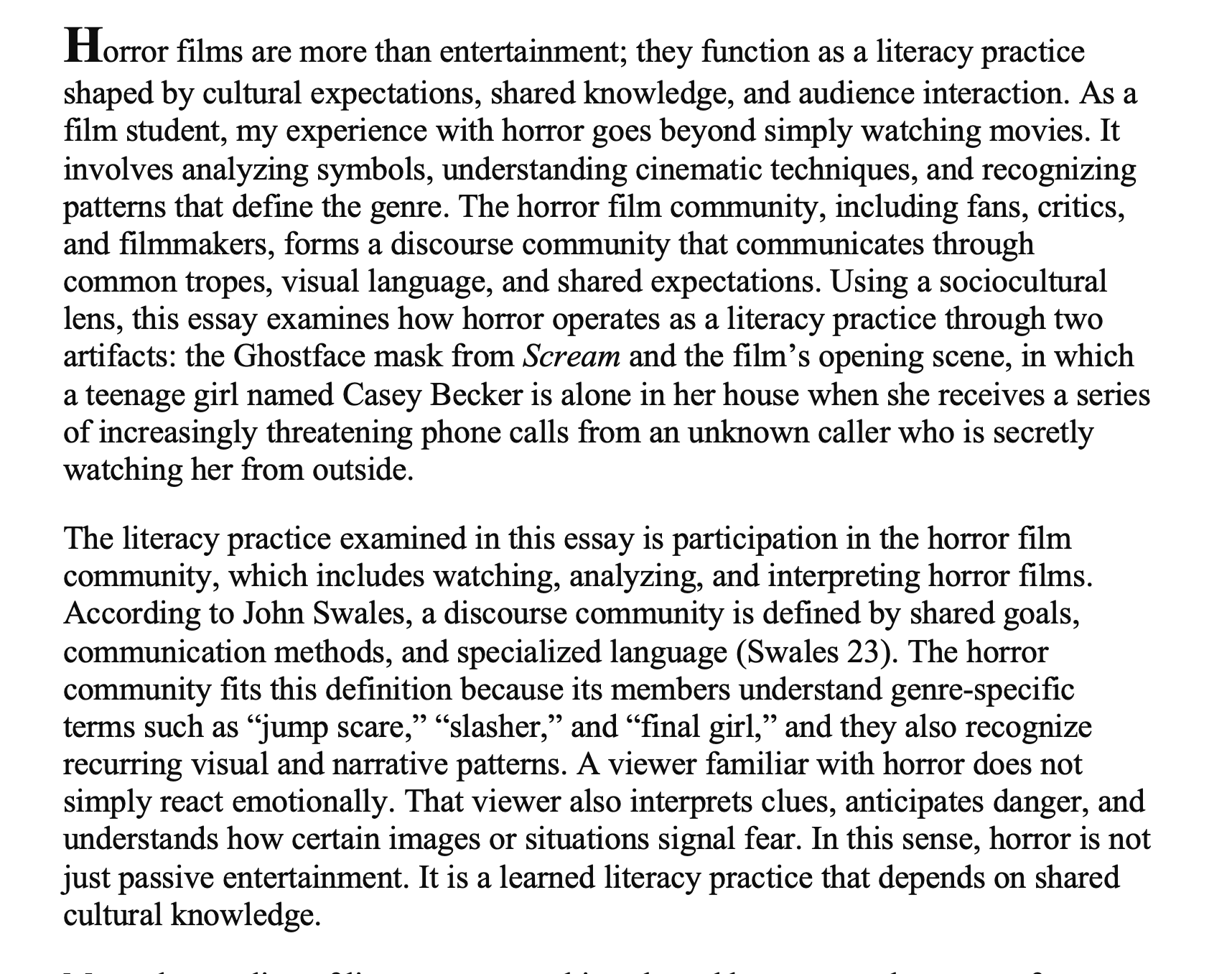
My MA2 was titled “Horror as a Literacy Practice: Analyzing the Ghostface Mask and the Opening Scene of Scream.” In this project, I analyzed horror as a discourse community and literacy practice. I focused on two artifacts from Scream: the Ghostface mask and the opening scene where Casey Becker receives a phone call that slowly turns from casual to terrifying.
The main argument of MA2 was that horror is not random. Horror works through symbols, patterns, audience expectations, and shared cultural knowledge. Fans of horror know how to interpret certain signs, such as masks, silence, isolation, phone calls, and sudden shifts in tone. This means horror audiences are not passive. They are actively reading and interpreting fear.
Reflection on MA2
MA2 helped me move from personal reflection into academic analysis. In MA1, I wrote mostly about my own experiences with language and identity. In MA2, I had to analyze a specific discourse community and use outside sources to support my argument. This was a major step in my development as a writer because I had to connect film analysis, course concepts, and scholarly sources.
One of the strongest parts of MA2 was the way I analyzed the Ghostface mask. The mask is simple, but it carries a lot of meaning within the horror community. It represents anonymity, danger, hidden violence, and unstable identity. Outside the context of horror, the mask could just look like a costume. Inside the horror discourse community, it immediately signals fear and threat. That helped me understand how meaning depends on context.
The opening scene of Scream also helped me understand horror as a literacy practice. The scene does not begin with violence. It begins with a normal phone call. The fear builds slowly through tone, silence, pacing, and psychological control. The audience recognizes danger before the character fully understands it. This showed me that horror depends on audience awareness and interpretation.
MA2 also connected strongly to multimodal composition. Even though the assignment was an essay, I was analyzing how film communicates through multiple modes: visuals, sound, dialogue, pacing, camera movement, and atmosphere. As a film student, this was important because it connected academic writing to the way I already think about cinema.
Course Outcomes Connected to MA2
Discourse Communities
MA2 connects directly to discourse communities because I analyzed horror audiences as a group that shares knowledge, language, expectations, and conventions. Terms like “slasher,” “final girl,” and “jump scare” are part of the horror community’s shared vocabulary.
Genre Conventions
This assignment helped me understand genre conventions. Horror films use patterns that audiences recognize, but strong horror films also play with those expectations. Scream is especially important because it is self-aware and uses the audience’s knowledge of horror against them.
Rhetorical Analysis
MA2 helped me practice rhetorical analysis by asking how meaning is created. I was not just describing the Ghostface mask or the opening scene. I was explaining how those artifacts communicate fear, identity, power, and vulnerability.
Multimodal Composition
This project also connects to multimodality because horror films communicate through more than words. They use image, sound, pacing, silence, lighting, and performance. This helped me understand that literacy can be visual and emotional, not only written.